Cash Drawer Count Sheet: How to Count, Balance, and Record Your Register
A cash drawer count sheet is a one-page record of exactly what was in your register at the end of a shift: how many of each bill and coin, the total, what the POS says should be there, and the difference between the two. The free cash drawer count sheet above does the math as you type, so you can focus on counting instead of adding.
If you have ever closed a register at 10 p.m. with a line of tired coworkers waiting to leave, you know the problem. Counting is easy. However, counting correctly, writing it down the same way every night, and being able to prove it a month later is the hard part. That is exactly what a count sheet is for.
Below you will find what goes on a good count sheet, how to fill one out step by step, a fully worked example, and what to do when the numbers do not match.
Quick summary
- Count the drawer at opening and at closing, and sign both counts.
- Expected cash = opening float + cash sales − paid-outs.
- Over/short = cash counted − expected cash.
- Under $1 off is normal. Repeated or larger gaps need a recount and a written note.
- Keep the sheets with your deposit slips and Z-reports for at least three years.
What Is a Cash Drawer Count Sheet?
A cash drawer count sheet (also called a cash count sheet, till count sheet, or register count sheet) is a form used to record the physical cash in a register and compare it to expected sales. In other words, it turns a pile of bills into a written number that someone has signed.
Most businesses use one twice a day:
- At opening, to confirm the starting cash (the float or bank) is complete before the first sale.
- At closing, to count everything, subtract the float, and check the result against the day’s cash sales.
Some stores also count at every shift change. That way, if money goes missing, you know which two or three hours to look at instead of the whole day.

Why a Written Cash Count Sheet Beats a Quick Tally
Of course, you could count the drawer on a calculator and move on. Plenty of small shops do. The trouble usually shows up later, when the bank deposit comes back $20 short or an owner asks why Tuesday was $40 over.
By contrast, a proper count sheet gives you three things a quick tally does not:
- A breakdown by denomination. For example, if the total is off by exactly $5, you can look at the fives and ones first instead of recounting everything.
- Accountability. The cashier signs it, and ideally a manager or second person does too. As a result, the honest employee is protected as much as the business.
- A paper trail. Bookkeepers, auditors, and insurance companies all ask for daily cash records. A stack of signed sheets, or a folder of saved PDFs, answers that question in minutes.
If you run a small business, this habit also pairs well with the other basics in our guide to cash management tips for small businesses.
What a Good Cash Drawer Count Sheet Includes
Every business tweaks its sheet a little, but the useful ones all share the same core fields. Here is what ours records and why each one matters.
Header details. Cashier name, register number, date, and shift (morning, evening, or overnight). Without these, a sheet is just numbers with no owner.
Opening float. The amount the drawer started with. Many US stores use somewhere between $100 and $300 depending on how much cash they take. Still, the right number is whatever your business sets and uses consistently.
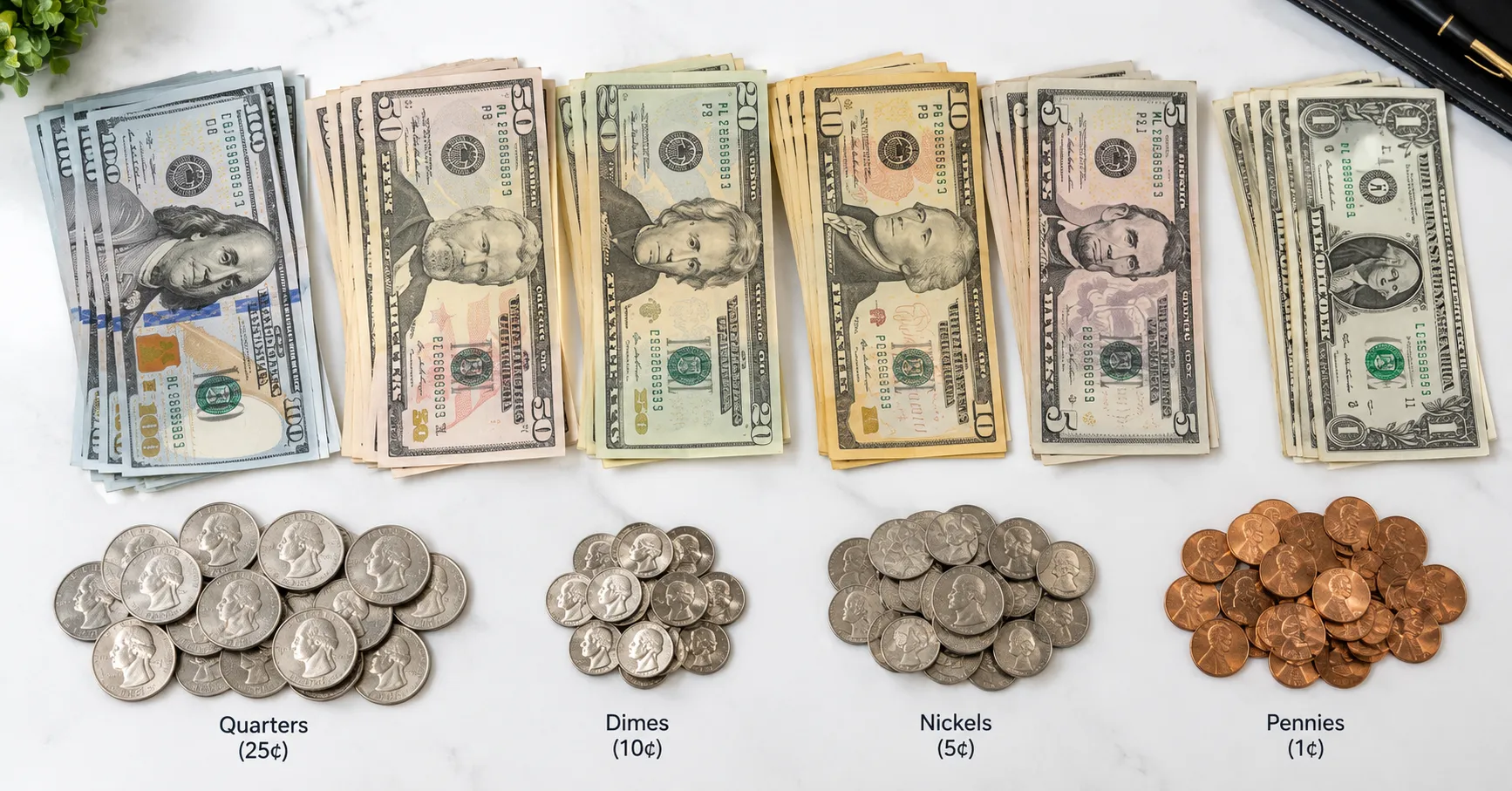
Bill counts. A line for each note: $100, $50, $20, $10, $5, $2, and $1. You enter the quantity, and then the sheet multiplies it out.
Coin counts. Quarters, dimes, nickels, and pennies, plus dollar coins if you take them. If you keep rolled coins in the drawer, count each roll at face value. Not sure what a roll holds? Our coin roll wrapper sizes and values chart lists every US roll.
Non-cash items. Checks, gift certificates, or vouchers that live in the drawer. Keep them on separate lines so they do not inflate your cash total.
Paid-outs. Any cash taken out during the shift for a business expense, like paying a delivery driver or buying ice. Each one should have a receipt. In larger offices, however, these are usually tracked in a petty cash log instead.
Expected cash. The cash sales figure from your POS or Z-report.
Over/short. The difference between what you counted and what you expected. Naturally, this is the number everyone cares about.
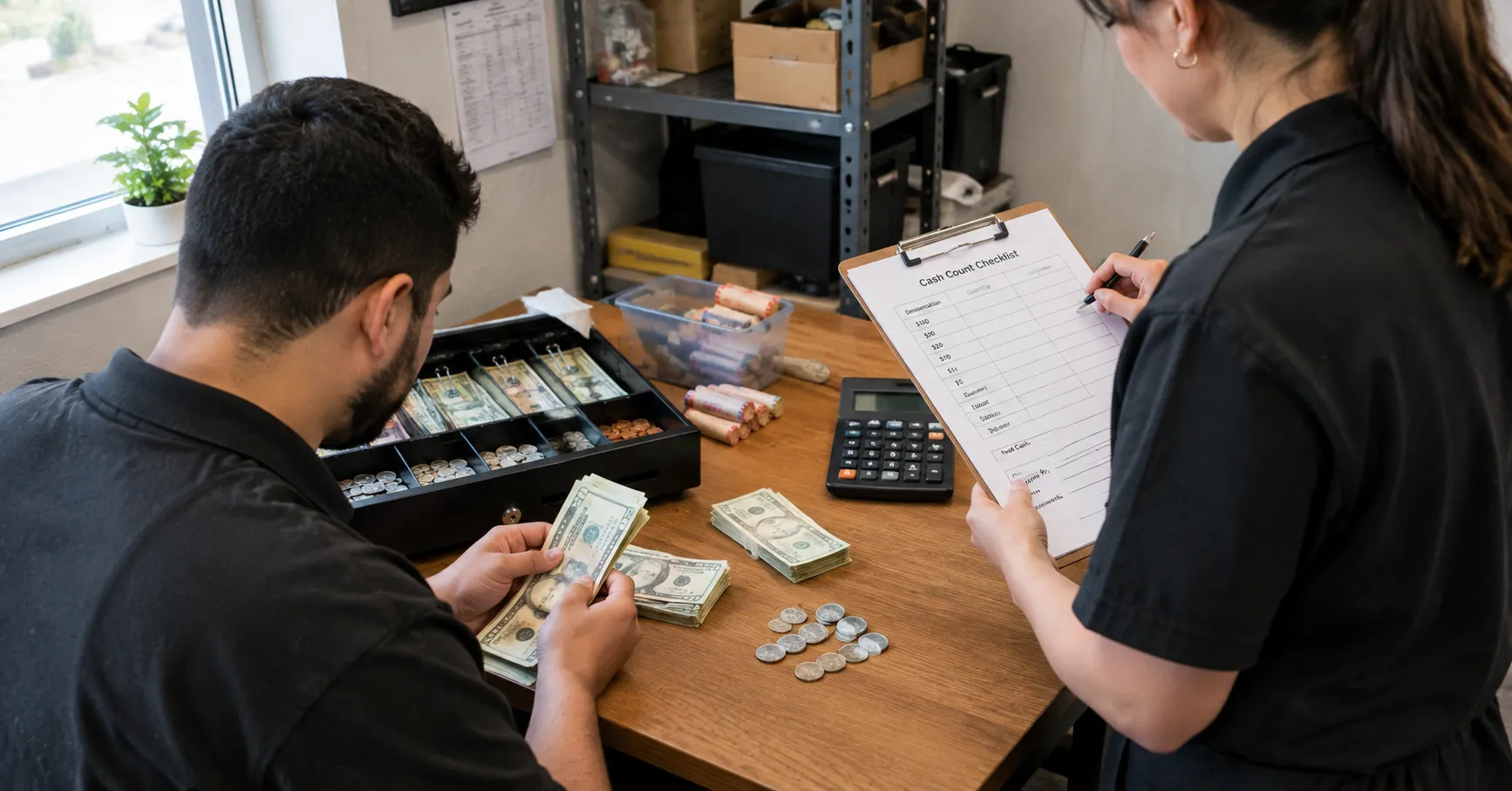
Signatures. The person who counted and the person who verified.
How to Fill Out a Cash Drawer Count Sheet, Step by Step
The steps below assume you are closing a single register. If you need the full counting routine, from pulling the drawer to sorting the bills, read our detailed guide on how to count a cash drawer. This section, on the other hand, focuses on getting the sheet right.
Before You Start Counting
Step 1: Close out the POS first. Run your end-of-shift or Z-report before you touch the cash, and write down the cash sales figure. Otherwise, if you count first, it is tempting to “find” the number you expect.
Step 2: Move the drawer somewhere quiet. A back office or a closed counter is ideal. Counting with customers around leads to interruptions, and interruptions lead to miscounts.
Step 3: Pull out the non-cash items. Next, set checks, vouchers, and paid-out receipts aside. Enter them on their own lines.
Counting Bills and Coins on the Count Sheet
Step 4: Sort and face the bills. Stack each denomination together, all facing the same way. Then count each stack twice. If the two counts disagree, count a third time before you write anything down. While you are handling the bills, it is also a good moment to glance at the larger notes for anything that looks or feels off. Our guide to spotting counterfeit money lists ten quick checks.
Step 5: Count the coins. First, count full rolls at face value, and then count the loose coins. Grouping loose coins into piles of a dollar (four quarters, ten dimes, twenty nickels) is faster than counting one by one. Our coin counter works well if you want to double-check the coins on their own.
Recording the Result
Step 6: Enter quantities, not totals. Type how many twenties you have, not how much they are worth. That way, the sheet multiplies for you, and you avoid simple math slips.
Step 7: Subtract the float. Take the opening float back out and set it aside for tomorrow. What remains is the cash you actually took in during the shift.
Step 8: Compare and sign. Finally, check the over/short figure. If it is within your store’s tolerance, sign the sheet, have a second person verify, and save or print it.
Cash Drawer Count Sheet Example (Filled Out)
Here is a real-world style example so you can see how the numbers flow. Maria closes register 2 on a Saturday evening. The drawer started with a $150 float. Meanwhile, the POS shows $690.00 in cash sales, and she paid $12.00 out of the drawer for a bag of ice (receipt attached).
| Denomination | Quantity | Value |
|---|---|---|
| $100 bills | 2 | $200.00 |
| $50 bills | 1 | $50.00 |
| $20 bills | 18 | $360.00 |
| $10 bills | 9 | $90.00 |
| $5 bills | 11 | $55.00 |
| $1 bills | 37 | $37.00 |
| Quarters | 103 | $25.75 |
| Dimes | 64 | $6.40 |
| Nickels | 49 | $2.45 |
| Pennies | 88 | $0.88 |
| Total cash counted | $827.48 |
Now for the reconciliation:
- Expected cash = opening float + cash sales − paid-outs
- Expected cash = $150.00 + $690.00 − $12.00 = $828.00
- Counted cash = $827.48
- Over/short = $827.48 − $828.00 = $0.52 short
Fifty-two cents short on a $690 day is normal. Typically, it comes from rounding, a dropped penny, or a cent or two of change given wrong. So Maria notes it, signs the sheet, and her manager initials it. After that, the $150 float goes back in the drawer, and $677.48 goes into the deposit bag.
If you want to plan exactly which bills to leave in the float, the denomination breakdown calculator will split $150 (or any amount) into a sensible mix of notes and coins.
What to Do When the Drawer Does Not Balance
Small differences happen in every business that takes cash. What matters, therefore, is how you respond. Here is a simple rule of thumb many managers use:
| Over/short amount | What it usually means | What to do |
|---|---|---|
| Under $1 | Rounding or a minor change error | Note it on the sheet and move on |
| $1 to $5 | Wrong change on one or two sales | Recount once, then note it |
| $5 to $20 | A missed count or one bill in the wrong stack | Recount every denomination and check the POS for voids or refunds |
| Over $20, or a repeat pattern | A real problem that needs follow-up | Recount with a manager, review the shift, and document in writing |
Your own limits may be tighter or looser. Either way, the key is to write the rule down so every cashier is judged the same way.
Before assuming theft, check the boring explanations first. The most common causes are a refund processed as cash instead of card, a paid-out without a receipt, a $20 counted as a $10, or a sale rung up twice. We cover these causes, and how to fix them, in our article on a cash drawer that is short or over.
One more point surprises new managers: an overage is not good news. For instance, if the drawer is $15 over, a customer likely left with $15 less change than they were owed. For this reason, treat overages with the same care as shortages.
Opening Count vs. Closing Count
The opening count is short. You are only confirming that the float is all there and in a useful mix: enough ones, fives, and quarters to make change for the first hour. If yesterday’s closer left the float as three $50 bills, for example, you will be in trouble by the second customer. A quick look at the change calculator shows how fast small bills disappear on a busy morning.
The closing count, in contrast, is the full process described above. It is also the one that ends up in your records, so it deserves the second signature.
A good habit is to have the closing cashier build tomorrow’s float and seal it, and then have the opening cashier count it before accepting it. If the two numbers match, nobody can argue later about when money went missing.
Paper or Digital Cash Drawer Count Sheet?
Both work. In the end, the best choice depends on how many registers you run and who needs to see the numbers.
| Printed paper sheet | Digital sheet (like the tool above) | |
|---|---|---|
| Math errors | Common, especially late at night | Totals and over/short calculated for you |
| Speed | Slower; every line added by hand | Faster; type quantities and read the result |
| Signatures | Easy, pen on paper | Print the finished sheet to sign, or note initials |
| Storage | Binders and filing boxes | PDF or Excel files, searchable by date |
| Works without power or internet | Yes | Needs a device; print a blank backup |
Many stores actually use a hybrid. They count with the online sheet, then print the result for signatures and keep a PDF copy as backup. Similarly, if your business handles cash in another currency, the same idea applies. You can count notes with our money counter for over 50 currencies, then copy the totals onto your sheet.
How Long Should You Keep Cash Drawer Count Sheets?
Treat count sheets as part of your business records. The IRS generally asks businesses to keep records that support income for at least three years, and longer in some situations, as explained on its page about how long to keep business records. Even so, check with your own accountant for the rule that fits your business and state.
Whatever period you choose, file the sheets in date order and keep them with the matching deposit slips and Z-reports. That way, when a question comes up, all three documents are in one place.
Common Mistakes That Throw Off a Count
After enough closing shifts, you start to see the same errors again and again:
- Forgetting the float. The cashier compares the full drawer total to cash sales and, as a result, reports a huge overage. Always subtract the starting amount.
- Counting rolled coins loose. Or worse, counting a roll twice: once as a roll and again after it is broken open.
- Mixing checks with cash. A $40 check in the cash total makes the drawer look $40 over.
- Unrecorded paid-outs. Someone takes $10 for supplies and means to drop off the receipt later. Then they forget, and the drawer comes up $10 short.
- Counting with interruptions. A phone call at the $20 stack is how 18 bills become 17.
- Mistaking a $1 for a $10 or a $10 for a $100. Bills facing different directions make this easy. Fortunately, facing and sorting first prevents most of it.
Likewise, when you strap larger amounts for the bank, use standard bundles so counts are quick to verify. Our guide on how many bills are in a bank strap has the full list.
Simple Rules That Make Counts More Reliable
You do not need a complicated policy. Instead, a few clear rules cover most situations:
- One cashier per drawer per shift, whenever possible. Shared drawers make shortages impossible to trace.
- Two people sign every closing count.
- Every paid-out needs a receipt in the drawer before the cash leaves it.
- Set a written over/short tolerance and apply it to everyone.
- Review the week’s sheets together, not just one day at a time. After all, one $3 shortage means little, but the same cashier at $3 short every Friday means something.
In addition, if cash leaves the business for small expenses outside the register, it helps to understand how a petty cash fund works and keep it separate from the drawer.
Frequently Asked Questions
What is a cash drawer count sheet?
A cash drawer count sheet is a form that records how many of each bill and coin are in a register, the total cash, the expected cash from sales, and any overage or shortage. The cashier and a verifier sign it at the end of each shift.
How do you calculate over/short on a cash drawer?
First, add the opening float and cash sales, then subtract any paid-outs to get expected cash. Next, subtract expected cash from the cash you counted. A positive result means the drawer is over, while a negative result means it is short.
How much cash should be in a register at the start of a shift?
Most small US businesses start with a float between $100 and $300, mostly in $1 and $5 bills plus rolled coins. However, the right amount depends on your sales volume and average transaction size.
What is an acceptable cash drawer shortage?
Many businesses treat anything under $1 to $5 as a normal counting or change error. On the other hand, larger amounts, or small shortages that repeat with the same cashier, should be investigated and documented.
Should the cash drawer be counted by one person or two?
One person should count, and a second person should verify and sign. This protects the cashier from false accusations and also makes the record more reliable.
Can I use the cash drawer count sheet for other currencies?
Yes. The process is the same for any currency. Simply count each note and coin, total it, subtract the float, and compare to expected sales.
Is this cash drawer count sheet free?
Yes. The count sheet on this page is free to use, needs no signup, and lets you save your report as a PDF or Excel file.
Start Using the Cash Drawer Count Sheet Tonight
A cash drawer count sheet takes about five minutes once you are used to it. In return, you get a clear answer to “is the money right?” every single day, plus a record that protects both you and your staff.
So scroll back up to the free count sheet, enter tonight’s numbers, and save the report. For more practical guides on handling cash, browse the MoneyCounter blog.