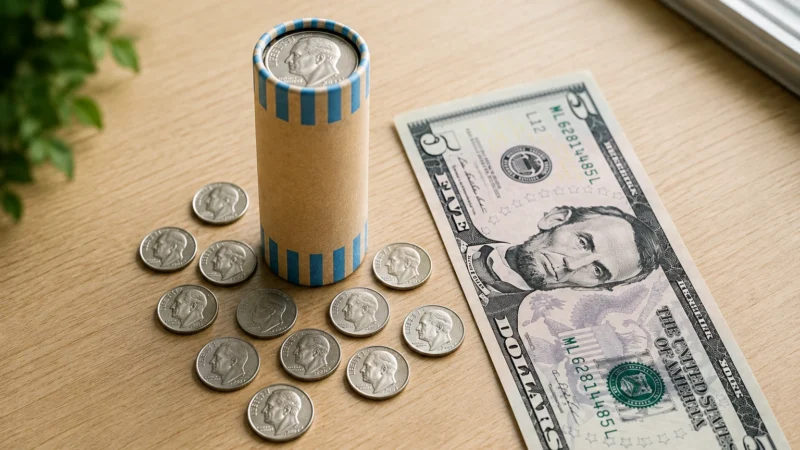
If you’ve got a stack of dimes and you’re wondering exactly what a full roll adds up to, here’s your answer: a standard roll of dimes is worth $5.00 and contains 50 coins.
Overall, dimes offer one of the best value-to-bulk ratios among common coin rolls, more value per roll than pennies or nickels, without needing as few coins as a quarter roll. This guide breaks down the exact numbers, how to roll your own dimes, and where dime rolls come up most often in everyday cash handling.
The Quick Answer: How Much Is a Roll of Dimes Worth
A standard U.S. coin roll of dimes contains 50 coins, and since each dime is worth $0.10:
50 x $0.10 = $5.00
That makes a dime roll worth exactly the same as a penny roll in coin count (both hold 50 coins), but ten times more valuable, a good illustration of just how much a coin’s face value affects its overall roll worth.
Standard Coin Roll Sizes (Quick Reference)
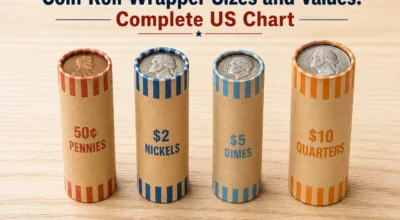
Here’s how dime rolls compare to the other three standard coin roll types:
| Coin Type | Coins Per Roll | Roll Value |
|---|---|---|
| Pennies | 50 | $0.50 |
| Nickels | 40 | $2.00 |
| Dimes | 50 | $5.00 |
| Quarters | 40 | $10.00 |
For a complete side-by-side breakdown of all four coin types, see our pillar guide, Coin Roll Wrapper Sizes and Values: Complete US Chart.

Why Dime Rolls Are a Good Value-to-Bulk Ratio
For example, because dimes are the smallest and lightest circulating U.S. coin, a roll of 50 dimes takes up relatively little physical space compared to a nickel or quarter roll of similar coin count, yet still carries a solid $5.00 in value. That combination of compact size and decent per-roll value is part of why dime rolls are a popular choice for bank tellers and small business owners who need to store or transport meaningful cash value without excessive bulk.
How to Roll Your Own Dimes
If you’re prepping a batch of dimes for a bank deposit, here’s the process:
- Sort your coins. Separate dimes from any other coin denominations mixed into your pile.
- Count out exactly 50 dimes per roll. Banks typically require exact counts for accepted deposits.
- Use a paper coin wrapper labeled for dimes (usually blue or light-blue, though colors can vary by manufacturer, always double check the label rather than relying on color alone). The Federal Reserve publishes standard wrapper color conventions that most banks follow.
- Fold and crease both ends of the wrapper to keep the coins secure.
- Label the roll if your bank requires identifying information for deposits.
Since dimes are small and can be easy to lose count of in a large pile, however, our free Coin Counter tool can help you keep an accurate running total as you sort.
How Many Rolls Do You Need for Common Amounts?
Here’s a quick reference for figuring out how many dime rolls you need to reach a specific dollar total:
| Dollar Amount | Number of Dime Rolls |
|---|---|
| $5 | 1 roll |
| $10 | 2 rolls |
| $25 | 5 rolls |
| $50 | 10 rolls |
| $100 | 20 rolls |
If you’re working from a loose coin count instead of a target dollar amount, our guides on how many dimes make a dollar and how many dimes make $10 cover those conversions step by step.
Real-World Situations Where This Matters
Bank deposits. Since a dime roll holds exactly 50 coins and $5.00 in value, knowing this in advance helps you calculate how many rolls you need before you even start sorting.
Small business change-making. Dimes are a common denomination for making exact change, and having pre-rolled dimes on hand speeds up cash drawer restocking during a shift. Our Cash Drawer Count Sheet tool can help track dime totals alongside every other denomination.
Coin jar cleanouts. If your loose change jar has a significant number of dimes, this conversion helps you quickly estimate the jar’s total value before sorting.
Coin collecting. For instance, dimes minted before 1965 contain 90% silver, so collectors sometimes search through dime rolls specifically looking for older, more valuable coins, a practice known as “roll hunting.”
A Faster Way to Count Large Dime Totals
Additionally, counting out 50 dimes per roll across multiple rolls takes time, especially when they’re small and easy to lose track of. Instead, use our free Money Counter tool to enter your quantities for pennies, nickels, dimes, and quarters together, and get an instant, accurate total, with export options for PDF, Excel, or CSV for your records.
Final Thoughts: How Much Is a Roll of Dimes Worth
So, how much is a roll of dimes worth? A standard roll contains 50 dimes and totals exactly $5.00, a solid value-to-bulk ratio among common U.S. coin rolls. Whether you’re prepping a bank deposit, restocking a cash drawer, or sorting a jar of loose change, now you know exactly what a dime roll is worth and how to count and wrap your own.
Ready to count a batch of loose dimes before rolling them? Try our free Coin Counter and get an instant, accurate total.
Frequently Asked Questions
How much is a roll of dimes worth?
A standard roll of dimes is worth $5.00 and contains 50 individual dimes.
How many dimes are in a roll?
There are exactly 50 dimes in a standard U.S. coin roll.
What color is a dime coin wrapper?
Dime wrappers are commonly blue or light-blue, though it’s best to check the label rather than rely on color alone, since wrapper colors can vary by manufacturer.
How many dime rolls do I need to make $50?
You would need exactly 10 dime rolls to reach $50, since each roll is worth $5.00.
Are pre-1965 dimes worth more than face value?
Yes. Dimes minted before 1965 contain 90% silver and are typically worth significantly more than face value to collectors, depending on current silver prices.
Why do dimes and pennies both have 50 coins per roll?
Roll sizes are set by long-standing U.S. Mint and Federal Reserve conventions based partly on coin size; dimes and pennies are similar enough in size that both use a 50-coin roll standard.
Do banks charge a fee to accept rolled dimes?
Most banks accept rolled coins for free from account holders, though non-customers may occasionally be charged a small fee. It’s best to confirm with your specific branch.
What’s the fastest way to count a large pile of dimes?
Sort them into stacks of 10 (each stack equals $1), or use a free tool like our Coin Counter to calculate an instant, accurate total.