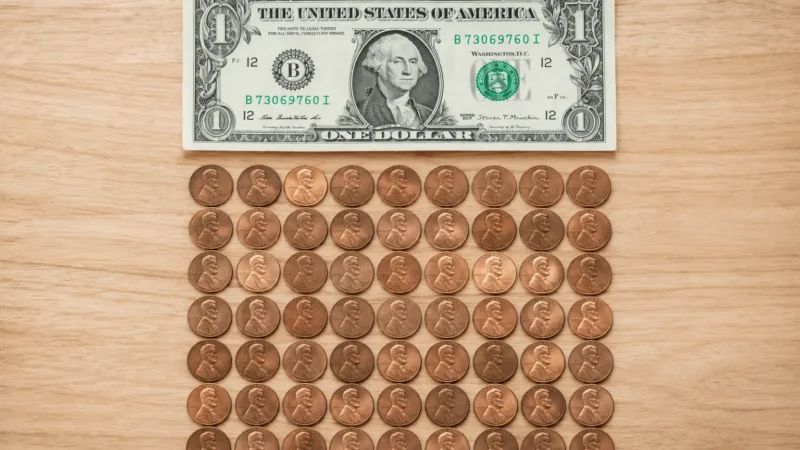
Every kid who’s ever dumped out a piggy bank has asked this question at some point: how many pennies make a dollar? The answer is straightforward: it takes exactly 100 pennies to make one dollar, since each penny is worth just 1 cent.
It sounds simple, and it is, but pennies come with a few quirks that other coins don’t have, from their odd production cost to the sheer bulk of coins it takes to reach even a modest amount. Let’s walk through the math, the practical side of handling pennies, and where they fit into everyday cash counting.
The Quick Answer: How Many Pennies Make a Dollar
A penny is worth $0.01, and a dollar equals $1.00. To calculate how many pennies make a dollar, divide the dollar amount by the penny’s value:
$1.00 ÷ $0.01 = 100 pennies
Because a penny is the smallest unit of U.S. currency, it takes more of them than any other coin to reach a dollar: 100 pennies, compared to just 10 dimes or 4 quarters.
How Many Pennies Make a Dollar? Other Amounts Explained
Once you know the base rate of 100 pennies per dollar, scaling up is just multiplication. Here’s a handy reference table:
| Dollar Amount | Number of Pennies |
|---|---|
| $1 | 100 pennies |
| $2 | 200 pennies |
| $5 | 500 pennies |
| $10 | 1,000 pennies |
| $20 | 2,000 pennies |
| $50 | 5,000 pennies |
| $100 | 10,000 pennies |
As you can see, pennies pile up fast. If you’re counting a jar that’s mostly pennies, doing this math by hand can take a while. Our free Coin Counter tool will total everything instantly once you enter your quantities.
What Does a Penny Look Like?
Pennies are easy to spot once you know what to look for:
- Color: Reddish-brown/copper-colored, unlike the silver tone of dimes, nickels, and quarters.
- Size: Slightly smaller than a nickel, but larger than a dime.
- Edge: Smooth, with no ridges, the same as nickels.
- Design: The obverse shows Abraham Lincoln’s profile; the reverse (since 2010) features a Union Shield design. Full specifications for every U.S. coin are published by the U.S. Mint.
The distinct copper color makes pennies the easiest coin to sort visually, even from across a room, which is part of why cashiers can often separate a mixed coin tray so quickly by sight alone.
Fun Fact: Pennies Cost More Than 1 Cent to Make
Here’s something that surprises a lot of people: the U.S. Mint has reported that it costs more than one cent to produce a single penny, largely due to the cost of zinc and copper materials plus minting expenses. This has fueled ongoing public debate over whether the U.S. should phase out the penny entirely, similar to what Canada did in 2013 when it discontinued its own penny. For now, though, the penny remains in circulation and still plays its role in everyday cash transactions and coin math.
Mixed Coin Combinations That Equal a Dollar
Pennies are often combined with other coins to reach a dollar more efficiently. Some common combinations:
- 100 pennies = $1.00 (pennies alone)
- 4 quarters = $1.00 (no pennies needed)
- 90 pennies + 2 nickels = $1.00
- 75 pennies + 1 quarter = $1.00
- 50 pennies + 5 dimes = $1.00
If you’re working through the full coin family, check out our companion guides on how many dimes make a dollar and how many nickels make a dollar to see how each coin scales differently.
How Many Pennies Are in a Standard Coin Roll?
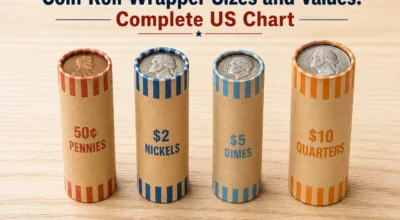
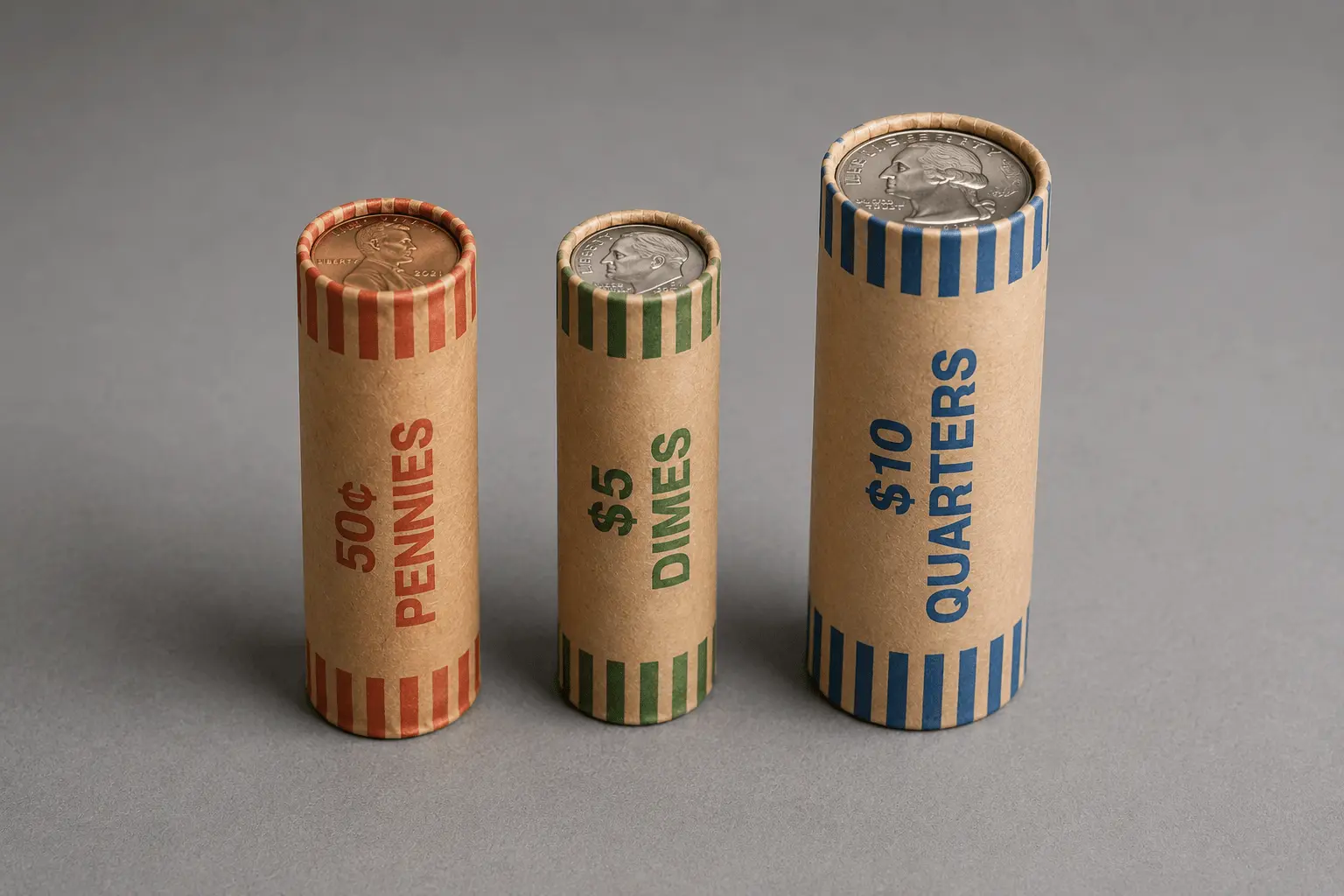
If you’re rolling pennies for a bank deposit, it’s worth knowing the standard count: a full penny roll contains 50 pennies, worth $0.50. That’s a smaller roll value than dimes ($5.00) or quarters ($10.00), which is part of why penny rolls take up more physical space for less value, something to keep in mind if you’re prepping a large deposit. For a full breakdown of roll values across every coin type, see our guide on how much a roll of pennies is worth.
Real-World Situations Where Penny Math Matters
Balancing a cash register. Pennies are usually the most numerous coin in any till, so quickly estimating their dollar value helps speed up end-of-shift reconciliation.
Teaching kids about money. Because 100 is a round, familiar number, pennies are often the first coin used to introduce the concept of “cents equal dollars” to young learners.
Coin jar sorting. If you’ve been tossing spare change into a jar for months, pennies typically make up the bulk of the volume. Knowing the 100-to-1 ratio helps you estimate the jar’s total value before you even count it.
Small business cash handling. Retailers that deal in cash still need accurate penny counts for register drawers, petty cash boxes, and change-making throughout the day.
A Faster Way to Count Large Penny Totals
Counting hundreds or thousands of pennies by hand is slow and easy to miscount. Instead, use our free Money Counter tool to enter your coin quantities across any combination of pennies, nickels, dimes, and quarters, and get an instant, accurate total, with the option to export your count as a PDF, Excel, or CSV file for recordkeeping.
Final Thoughts on How Many Pennies Make a Dollar
So, how many pennies make a dollar? The answer is 100, always 100, since each penny represents exactly one cent. Whether you’re teaching a child basic money math, sorting a jar of spare change, or balancing a cash drawer at the end of a shift, this simple ratio is one of the most useful pieces of coin knowledge to have on hand.
Ready to count a whole jar of pennies without doing the math yourself? Try our free Coin Counter and get your total instantly.
Frequently Asked Questions
How many pennies make a dollar?
It takes exactly 100 pennies to make one dollar, since each penny is worth 1 cent and a dollar equals 100 cents.
How many pennies are in $5?
There are 500 pennies in $5. Multiply the dollar amount by 100 to find the penny count for any amount.
How many pennies are in a standard roll?
A standard U.S. penny roll contains 50 pennies, with a total value of $0.50.
What is a penny made of?
Modern U.S. pennies are made primarily of zinc with a thin copper coating, giving them their signature reddish-brown color.
Does it really cost more than a penny to make a penny?
Yes. Due to material and production costs, the U.S. Mint has reported that producing a single penny costs more than one cent, which has led to ongoing debate about discontinuing the coin.
How many pennies make $100?
It takes 10,000 pennies to make $100, the equivalent of 200 standard penny rolls.
What’s the difference between old and new pennies?
Pennies made before 1982 are composed of 95% copper, while modern pennies are mostly zinc with a copper coating, making older pennies denser and slightly more valuable to collectors.
What’s the fastest way to count a large jar of pennies?
Weighing them on a scale can give a rough estimate, but for an exact total, sort them into rolls of 50 or use a free tool like our Coin Counter to calculate the total instantly.