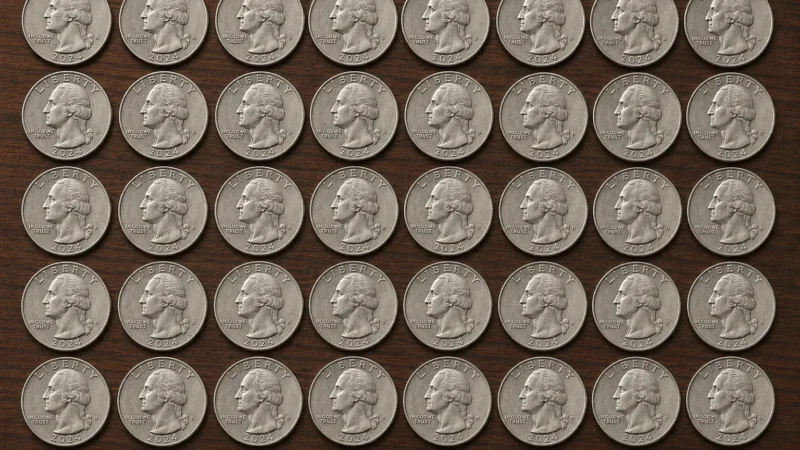
If you want to know how many quarters make $10, the answer is exactly 40 quarters. Each quarter is worth $0.25, and 40 times $0.25 equals $10.00. This guide goes further than just that one answer. Whether you are counting coins for a cash register, teaching a child about money, or emptying a coin jar, you will find exact quarter counts for every common dollar amount right here. You will also find the same information for dimes, nickels, and pennies.
How Many Quarters Make $10 and Other Common Amounts?
Since each quarter is worth $0.25, you can find the number of quarters for any dollar amount by dividing that amount by 0.25. For example, $10 divided by $0.25 equals 40 quarters. The table below gives you the exact quarter count for every common dollar amount so you never have to calculate from scratch again.
| Dollar Amount | Number of Quarters | Verification |
|---|---|---|
| $1.00 | 4 quarters | 4 x $0.25 = $1.00 |
| $2.00 | 8 quarters | 8 x $0.25 = $2.00 |
| $5.00 | 20 quarters | 20 x $0.25 = $5.00 |
| $10.00 | 40 quarters | 40 x $0.25 = $10.00 |
| $20.00 | 80 quarters | 80 x $0.25 = $20.00 |
| $25.00 | 100 quarters | 100 x $0.25 = $25.00 (1 full roll) |
| $50.00 | 200 quarters | 200 x $0.25 = $50.00 |
| $100.00 | 400 quarters | 400 x $0.25 = $100.00 |
One useful fact to remember: a standard roll of quarters contains exactly 40 coins and is worth $10.00. So when someone asks how many quarters make $10, the answer also equals one complete coin roll. This makes it easy to think in rolls when you are dealing with large quantities of quarters.
How Many Quarters Make $1 to $100: Full Reference
This extended table covers the full range from $1 to $100 so you have a complete reference on hand for any situation.
| Amount | Quarters Needed | Rolls of Quarters |
|---|---|---|
| $1.00 | 4 | 0.1 rolls |
| $5.00 | 20 | 0.5 rolls |
| $10.00 | 40 | 1 roll |
| $25.00 | 100 | 2.5 rolls |
| $50.00 | 200 | 5 rolls |
| $75.00 | 300 | 7.5 rolls |
| $100.00 | 400 | 10 rolls |
Complete Coin Reference: Quarters, Dimes, Nickels, and Pennies
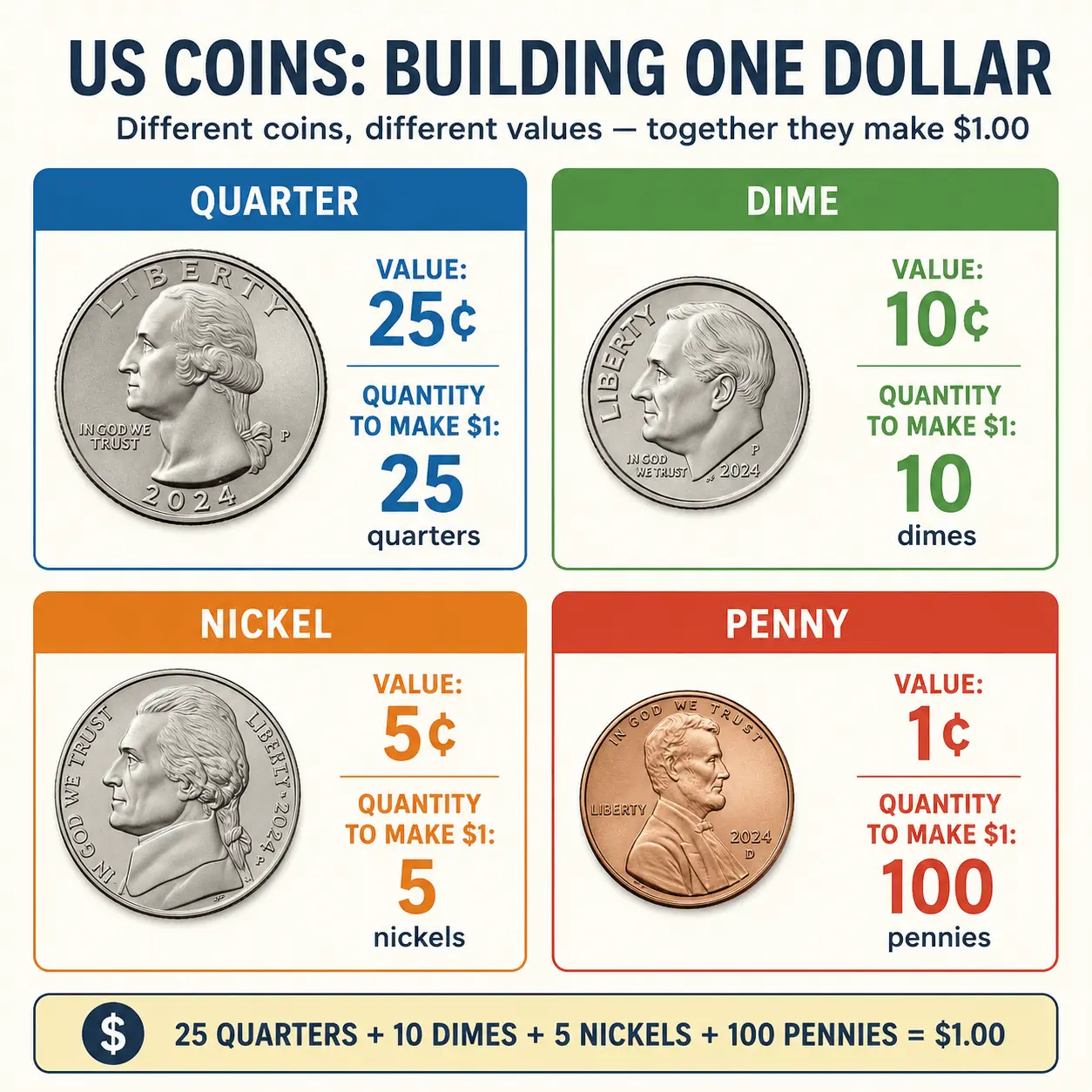
Of course, quarters are not the only coin you need to count. The table below covers all four main US coin denominations for the most common dollar amounts. This makes it easy to compare coin types side by side.
| Amount | Quarters ($0.25) | Dimes ($0.10) | Nickels ($0.05) | Pennies ($0.01) |
|---|---|---|---|---|
| $0.25 | 1 | 2.5 | 5 | 25 |
| $0.50 | 2 | 5 | 10 | 50 |
| $1.00 | 4 | 10 | 20 | 100 |
| $5.00 | 20 | 50 | 100 | 500 |
| $10.00 | 40 | 100 | 200 | 1,000 |
| $20.00 | 80 | 200 | 400 | 2,000 |
| $25.00 | 100 | 250 | 500 | 2,500 |
As you can see, pennies become impractical very quickly for large amounts. For example, making $10 with pennies requires 1,000 individual coins. This is why cashiers and coin counters always start with the highest-value coin and work down when counting mixed coins.
Coin Roll Values: The Fastest Way to Count Quarters
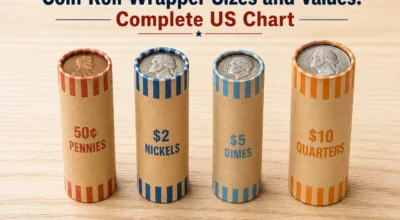
When you have a large number of quarters, rolling them is by far the most efficient approach. Standard US coin rolls contain a fixed number of coins and are worth a fixed dollar amount. Here are the standard values for all four coin types.
| Coin | Value Each | Coins per Roll | Roll Value |
|---|---|---|---|
| Penny | $0.01 | 50 coins | $0.50 |
| Nickel | $0.05 | 40 coins | $2.00 |
| Dime | $0.10 | 50 coins | $5.00 |
| Quarter | $0.25 | 40 coins | $10.00 |
| Half Dollar | $0.50 | 20 coins | $10.00 |
| Dollar Coin | $1.00 | 25 coins | $25.00 |
Once you know these roll values, counting large quantities of coins becomes much faster. Instead of counting 40 individual quarters, you simply confirm you have a full roll and know it is worth $10.00. Furthermore, rolled coins are processed faster at the bank because the teller does not need to count individual coins.
According to the US Mint circulating coins page, quarters are one of the most produced coins in American history. In addition, the Federal Reserve tracks coin production and circulation data that shows quarters remain the most commonly used large coin in everyday US transactions.
How to Count Quarters Quickly
If you have a pile of quarters and need to count them fast, these three methods work best in practice.
Method 1: Stack and Count Quarters in Groups
First, stack quarters into groups of 4. Each group of 4 is exactly $1.00. Then count your stacks and multiply by $1.00. This is faster than counting individual coins because you work in dollar units instead of $0.25 increments.
Method 2: Count Quarters by Value
Instead of counting “one, two, three, four quarters,” count by value: “25 cents, 50 cents, 75 cents, one dollar.” This gives you a running dollar total as you go. As a result, you skip the multiplication step at the end and reduce the chance of losing count.
Method 3: Roll Quarters into Coin Wrappers
For large quantities, roll into standard quarter rolls of 40 coins, each worth $10.00. Then multiply the number of rolls by $10.00. This is the fastest method for large coin counts and also makes bank deposits much simpler.
For a full guide on all coin counting methods, see our article on how to count coins fast.
Common Mistakes When Counting Quarters
Even experienced cashiers make a few common mistakes when counting quarters. However, being aware of them helps you avoid them.
- Mixing denominations before counting: Always separate quarters from other coins first. A dime can look similar to a quarter in poor lighting, and mixing them throws off your count.
- Losing count mid-pile: If something interrupts you, place a physical marker between counted and uncounted coins. Recounting from zero is always safer than guessing where you stopped.
- Inconsistent stack heights: When stacking quarters to count, keep stacks at a consistent height such as 10 coins each. Irregular stacks make it easy to miscount.
- Not double-checking before recording: Always count your quarters twice before writing down the total, especially for large amounts. A two-coin error on quarters is a $0.50 discrepancy that adds up over time.