Good cash management is one of the most important habits a small business can build — and one of the most commonly neglected. Many business owners focus on sales and inventory, but overlook the simple daily processes that keep their cash accurate, secure, and properly recorded.
The good news is that effective cash management does not require expensive software or a dedicated finance team. In fact, most of the strategies in this guide take less than ten minutes a day to implement. Together, they can significantly reduce cash discrepancies, prevent petty theft, and give you a much clearer picture of your business’s financial health.
1. Count Your Cash Drawer at the Start and End of Every Shift
This is the single most effective cash management habit a retail business can build. Counting your drawer at the beginning of the shift confirms your opening float. Counting it again at the end tells you whether your cash matches your recorded sales.
Use our free Cash Drawer Count Sheet to record each count consistently. The tool calculates your total automatically and flags any discrepancy between your expected and actual closing balance. Furthermore, having a written record of every count creates an audit trail that is invaluable if a discrepancy needs to be investigated later.
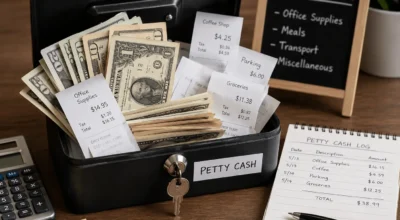
2. Set Up a Petty Cash Fund
A petty cash fund is a small amount of cash — typically between $50 and $200 — kept on hand for minor day-to-day business expenses such as postage, cleaning supplies, or small equipment repairs.
Without a system, petty cash is one of the easiest places for money to go missing. To keep it under control, designate a single person to manage the fund, require a receipt for every withdrawal, and reconcile the fund at the end of each week. Our free Petty Cash Log makes this process straightforward — simply log each transaction as it happens, and the running balance updates automatically.
3. Never Leave the Register Unattended and Unlocked
This is a basic rule that is surprisingly easy to overlook during a busy shift. A cash drawer left open and unattended — even for thirty seconds — is an unnecessary risk. Train all staff to close and lock the drawer whenever they step away, even briefly.
Additionally, make it a policy that only the assigned cashier accesses a particular drawer during their shift. Shared access makes it much harder to identify who is responsible when a discrepancy occurs.
4. Use a Consistent Opening Float
Your opening float is the amount of cash you start with in the drawer at the beginning of each shift. Using a consistent amount — say $200 — makes it much easier to spot discrepancies at the end of the day, since your expected closing balance is always calculated from the same starting point.
Moreover, a consistent float ensures your cashiers always have the right denomination mix to make change efficiently, which reduces the need to break large bills during busy periods.
5. Reconcile Daily, Not Weekly
Many small business owners reconcile their cash at the end of the week rather than daily. However, weekly reconciliation means that any errors or discrepancies have had five days to compound and become harder to trace.
Daily reconciliation takes only a few minutes and makes problems much easier to catch. If your closing count is off by $20 today, you know to look at today’s transactions. If you wait until Friday, you are reviewing five days’ worth of activity — a much more time-consuming process.
6. Record Every Transaction
Every cash transaction — whether a sale, a refund, or a petty cash withdrawal — should be recorded at the time it happens. This sounds obvious, but it is easy to skip in a busy environment, particularly for small amounts.
The record does not need to be elaborate. A simple description, amount, and date is sufficient for most purposes. Over time, consistent recordkeeping makes your end-of-day reconciliation faster, your audits cleaner, and your cash forecasting more accurate.
7. Keep Large Bills Separate
When a customer pays with a $50 or $100 bill, slide it under the drawer tray rather than mixing it with the rest of the cash. This simple habit serves two purposes: it makes it harder to accidentally give change from a large bill before confirming it, and it keeps large notes separate for easy identification during end-of-day counting.
Some businesses also use a counterfeit detection pen on large bills as a matter of routine. As a result, they avoid accepting fraudulent notes that would otherwise only be caught at the bank.
8. Limit Who Has Access to the Safe
If your business uses a safe to store cash overnight, limit access to the minimum number of people necessary. Every additional person with safe access increases the risk — not because of distrust, but because it increases the number of variables if a discrepancy occurs.
Additionally, change the safe combination whenever a staff member with access leaves the business. This is a standard security practice that many small businesses overlook.
9. Use the Denomination Breakdown Calculator for Bank Deposits
When preparing a bank deposit, it helps to know the most efficient way to organize your cash by denomination. Our free Denomination Breakdown Calculator shows you exactly how many bills of each type make up your deposit total, which makes the bank’s job easier and reduces errors on deposit slips.
10. Train New Staff on Cash Handling Procedures from Day One
Cash handling errors are far more common among new employees who have not been properly trained than among experienced staff. Consequently, investing time in training on day one pays significant dividends in reduced errors and discrepancies over the long term.
A simple written procedure — covering how to count the opening float, handle transactions, make change, and close the drawer — gives new cashiers a clear reference point and reduces the likelihood of avoidable mistakes.