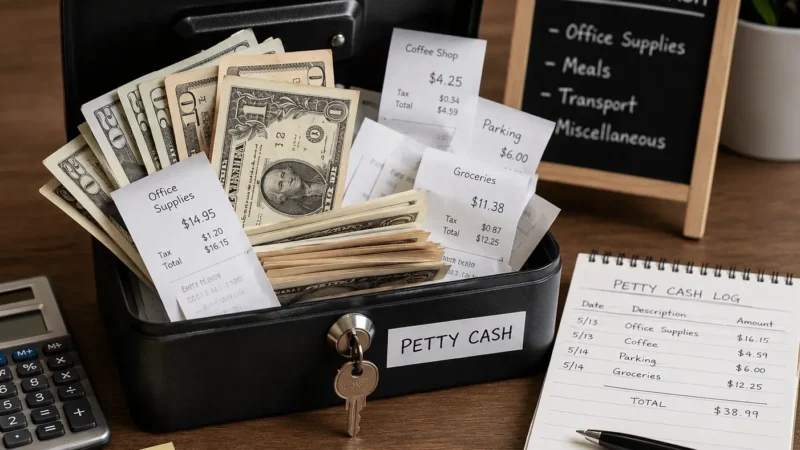
If you run a small business, manage a retail store, or work in an office, you have almost certainly encountered a petty cash fund — even if you have never heard it called by that name. Essentially, it is a small amount of cash kept on hand for everyday minor expenses that do not warrant writing a check, processing a card payment, or going through a formal approval process.
Understanding what is petty cash, how to set it up correctly, and how to manage it properly saves your business significant time. Furthermore, a well-structured system protects against the misuse and accounting errors that loosely managed funds consistently produce.
Petty Cash Definition
Petty cash is a small, designated fund of physical cash that a business keeps readily accessible for minor, routine expenses that are too small or too immediate for normal payment processes. The term “petty” comes from the French “petit,” meaning small — referring to the relatively minor amounts involved.
In practice, the fund typically covers expenses like these:
- Office supplies (printer paper, pens, notebooks)
- Postage and shipping costs for small packages
- Coffee or refreshments for a small team meeting
- Minor equipment repairs or low-cost replacement parts
- Local transportation costs (taxi fare, parking, bus)
- Small cleaning or maintenance supplies
- Unexpected minor expenses that arise during a normal workday
The fund is intentionally kept small — typically between $50 and $500 for most small businesses. The goal is enough cash to cover routine needs without keeping a large, high-risk amount of currency on the premises. For guidance on how small business cash expenses are categorized for tax purposes, see the IRS recordkeeping guidelines for small businesses.
How Petty Cash Works — The Imprest System
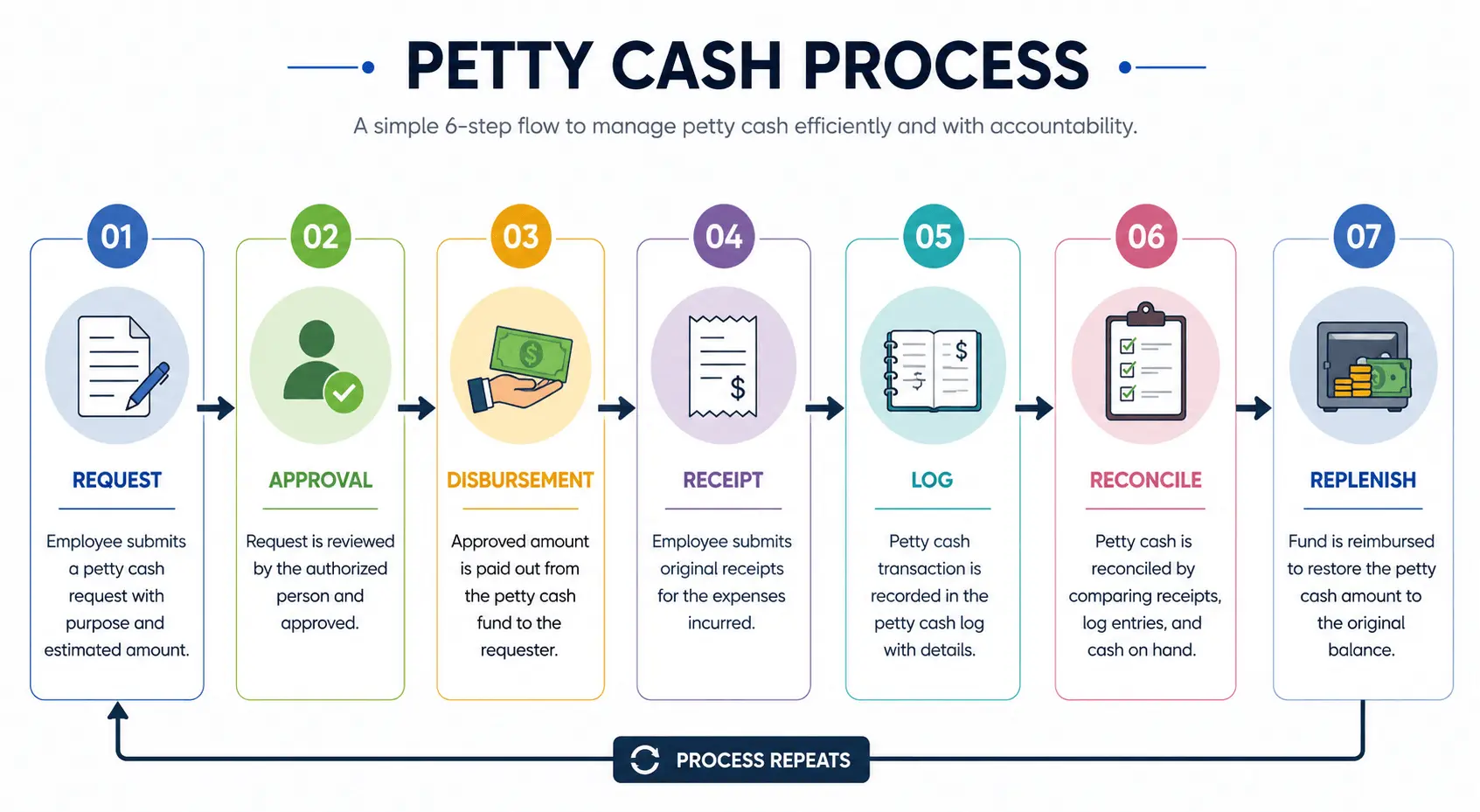
Most businesses manage the fund using the imprest system. The concept is straightforward: you establish a fixed amount, and every time money goes out, you replenish the fund back to that original amount — so the balance always returns to the same starting point.
Here is how a complete cycle works under the imprest system:
- Establish the fund: First, decide on a fund size appropriate for your business (for example, $200). Withdraw this amount from the business account and place it in a secure lockable cash box.
- Appoint a custodian: Next, designate one person — the custodian — who takes responsibility for the cash box, approves disbursements, and keeps the log current.
- Record every transaction: Each time money goes out, the custodian logs the date, amount, purpose, and recipient. Attach a receipt or voucher to every disbursement — no exceptions.
- Reconcile regularly: At week’s end, or when the fund drops to a replenishment threshold, the custodian counts remaining cash, totals the receipts, and confirms that cash + receipts = original fund amount.
- Replenish: Finally, accounting reviews the log, approves the expenses, and issues a check to restore the fund to its original fixed amount.
Under this system, the account in your bookkeeping software always shows the fixed fund amount as a current asset — because the cash spent offsets against receipts that accounting clears during replenishment.
How to Set Up a Petty Cash Fund — Step by Step
Step 1: Determine the Right Fund Size
Ultimately, the right amount depends on how frequently your business incurs small cash expenses. A practical guideline: set the fund at roughly two to four weeks of minor cash needs, so you avoid replenishing it every other day. For most small offices, $100 to $300 is appropriate. For retail businesses with more frequent small purchases, $300 to $500 is more practical. Start conservatively — you can always increase the amount once you see the actual usage pattern.
Step 2: Choose a Secure, Dedicated Location
For security, store the fund in a lockable metal cash box or small safe, kept in an area with limited access — a locked office drawer or cabinet works well. Only the designated custodian and an authorizing manager should hold a key. The goal is controlled access, not secrecy.
Step 3: Write Your Policy
Before anything else, write down the rules — even a single page is enough. Your policy should state: the fund amount, who the custodian is, which expense types the business allows, the maximum single-transaction limit, the receipt requirement, how often reconciliation occurs, and who authorizes replenishment. As a result, enforcement becomes straightforward and ambiguity disappears.
Step 4: Start the Log
Above all, record every disbursement at the moment it happens — not at the end of the day. Each entry should include: date, amount, category, purpose, recipient name, and receipt reference. Our free Petty Cash Log handles this automatically — enter the transaction and your running balance updates instantly, so you always know exactly how much remains in the box.
Common Petty Cash Mistakes — and How to Fix Them
Even well-intentioned teams make these errors. Therefore, review this list before opening your fund:
| Mistake | Why It Happens | Prevention |
|---|---|---|
| No receipts required | Small amounts feel trivial | No receipt, no reimbursement — enforce without exceptions |
| No single custodian | Everyone has access | One custodian only; limit key access strictly |
| Monthly reconciliation only | Feels like less work | Weekly counts take 5 minutes and catch errors early |
| Unapproved expense types | No written policy | Define approved categories explicitly in writing |
| Mixed with register cash | Space constraints | Always use a separate dedicated lockable box |
Petty Cash vs. Cash Float — Key Difference
These two terms are frequently confused, particularly in retail. In contrast to a cash float, a petty cash fund pays for business expenses — supplies, postage, travel — and the money flows out permanently as an expense. A cash float, on the other hand, is the starting amount a business places in a register at the beginning of a shift to make change for customers. It is not an expense — it is working capital that cycles through transactions and comes back at shift end.
In both cases, careful tracking is essential — but through different tools. For register float management, use our Cash Drawer Count Sheet. For the expense fund, similarly, use our Petty Cash Log.