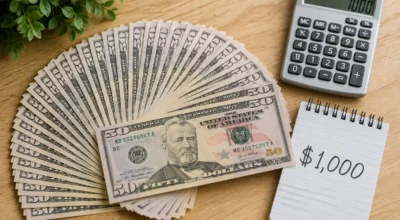
If you’re asking how many $100 bills make $10000, the answer is simple: it takes exactly 100 bills. That’s the short version — but if you’re counting a real stack of hundreds for a bank deposit, a business payout, or just double-checking a drawer, there’s more worth knowing so you don’t come up short.
So, this guide breaks down the math behind how many $100 bills make $10000, shows how banks bundle the bills, and gives you a few tricks for counting large amounts of cash quickly.
How Many $100 Bills Make $10000? The Quick Math
Here’s the simple version:
$10000 ÷ $100 = 100 bills
In other words, every $100 bill you add gets you 1% closer to the total. So, once you’ve got 100 individual hundred-dollar bills in front of you, that stack is worth exactly $10000 — no more, no less.
How Banks Bundle $100 Bills Into $10000 Straps
For example, anyone who’s picked up cash from a bank teller has probably noticed the bills aren’t loose — they arrive in neat, wrapped bundles. Here’s how that breaks down for hundreds:
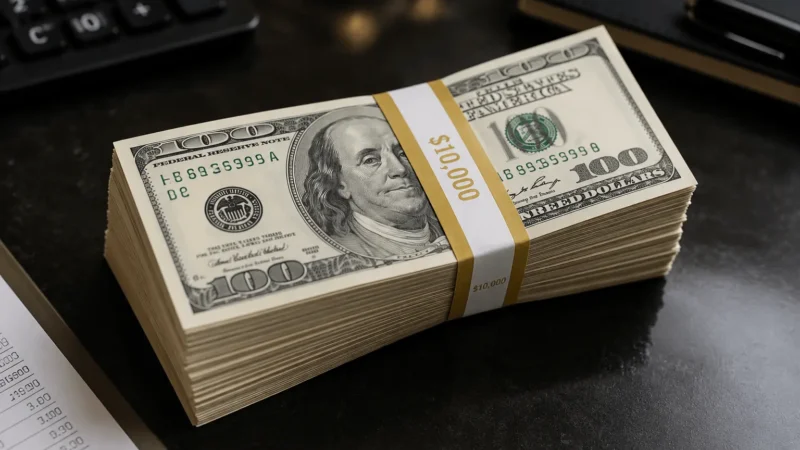
- A strap of 100 bills equals $10000. This is the standard “full strap” most U.S. banks use, usually held together with a colored paper band.
- A bank bundle of 10 straps, on the other hand, equals $100,000. Businesses and armored transport services typically order cash in this size.
As a result, a single full strap from a bank already contains $10000 in $100 bills — you don’t need to count a single bill yourself, as long as the strap hasn’t been broken open.
Why Knowing How Many $100 Bills Make $10000 Matters
In fact, a few situations where this comes up more than people expect:
- Cashiers and bank tellers confirming a deposit or till total.
- Small business owners handling a large cash sale or an end-of-day count.
- Anyone receiving a cash payment who wants to verify the amount fast.
- Bookkeepers reconciling a cash drawer against a point-of-sale report.
Once you know the count, therefore, you can eyeball a stack, group it into batches of 10, and confirm the total in seconds.
Faster Ways to Count 100 Bills
Counting bills one at a time works, but it’s slow, and mistakes creep in that way. Instead, try these three methods:
- Count in stacks of 10. Split the bills into 10 small stacks of 10 bills each. Ten stacks of $1,000 add up fast, and you’ll spot a short stack immediately.
- Use the fan-and-flip method. Fan a small group of bills with your thumb and count as you flip through — bank tellers use this to move through large amounts quickly while still catching duplicates.
- Use a digital tool. For a business, skip manual counting altogether. Our Money Counter tool totals your bill and coin counts instantly and gives you a printable breakdown for your records.
Quick Reference Table
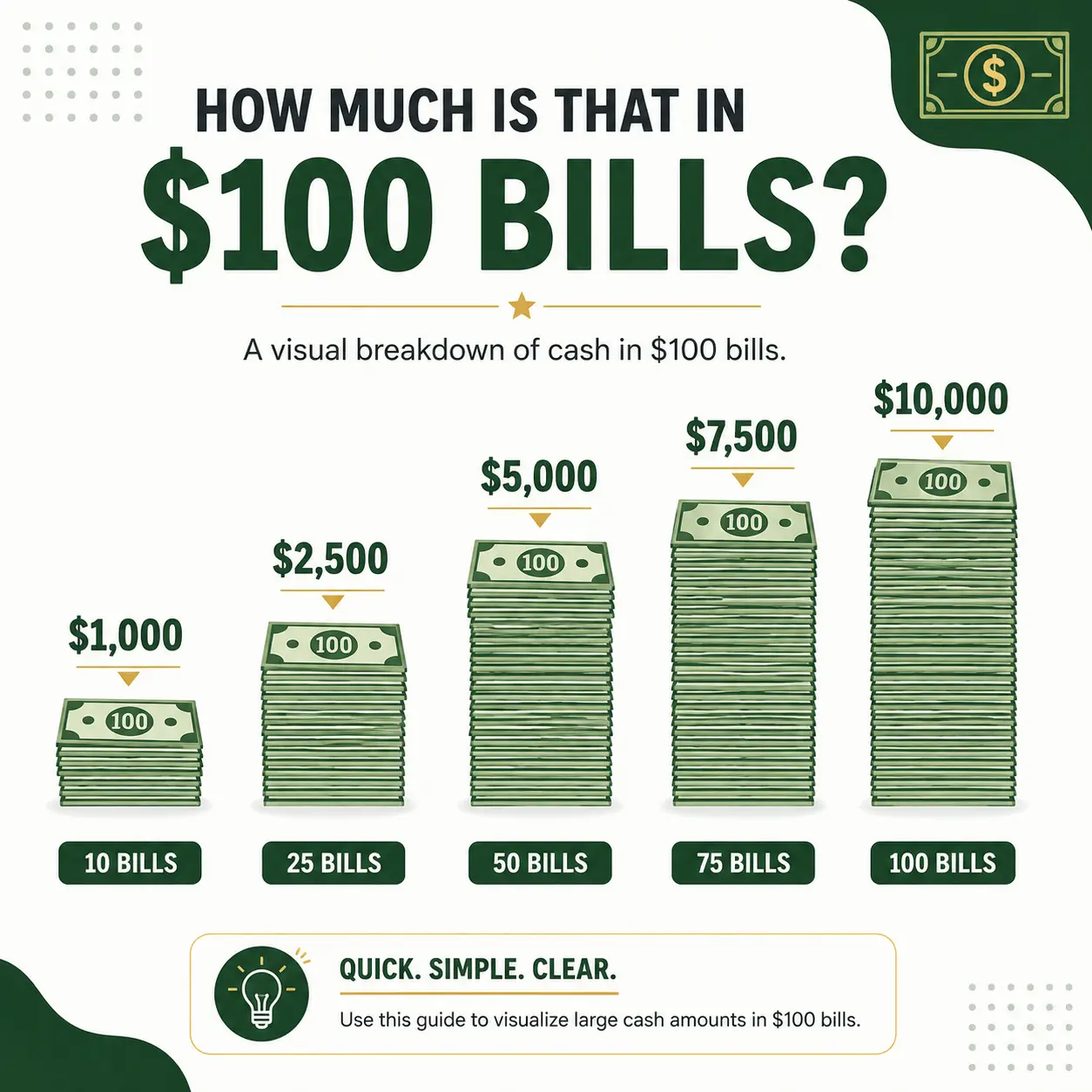
| Number of $100 Bills | Total Value |
|---|---|
| 10 bills | $1,000 |
| 25 bills | $2,500 |
| 50 bills | $5,000 |
| 75 bills | $7,500 |
| 100 bills | $10000 |
Frequently Asked Questions
How many $100 bills are in a bank strap?
A standard bank strap holds 100 bills. So, for hundred-dollar bills, that strap equals $10000.
What does $10000 in $100 bills weigh?
The U.S. Bureau of Engraving and Printing confirms every U.S. bill weighs about 1 gram regardless of denomination. Therefore, 100 bills weigh roughly 100 grams — close to the weight of a deck of playing cards.
Do banks report cash deposits of $10000 or more?
Yes. Under federal law, banks automatically file a report on cash deposits or withdrawals of $10000 or more. That said, this is routine and doesn’t mean anything is wrong — it’s a standard currency transaction report.
How many $100 bills would you need for $1 million?
You would need 10,000 bills of $100 to reach $1,000,000.
The Bottom Line
Ultimately, whether you’re a business owner counting daily cash, a teller confirming a deposit, or just curious, the answer to how many $100 bills make $10000 stays simple: it always takes 100 bills. Once you understand how banks bundle bills into straps, counting large stacks gets much faster — and if you’d rather skip the manual math, our Money Counter tool totals any mix of bills and coins in seconds.