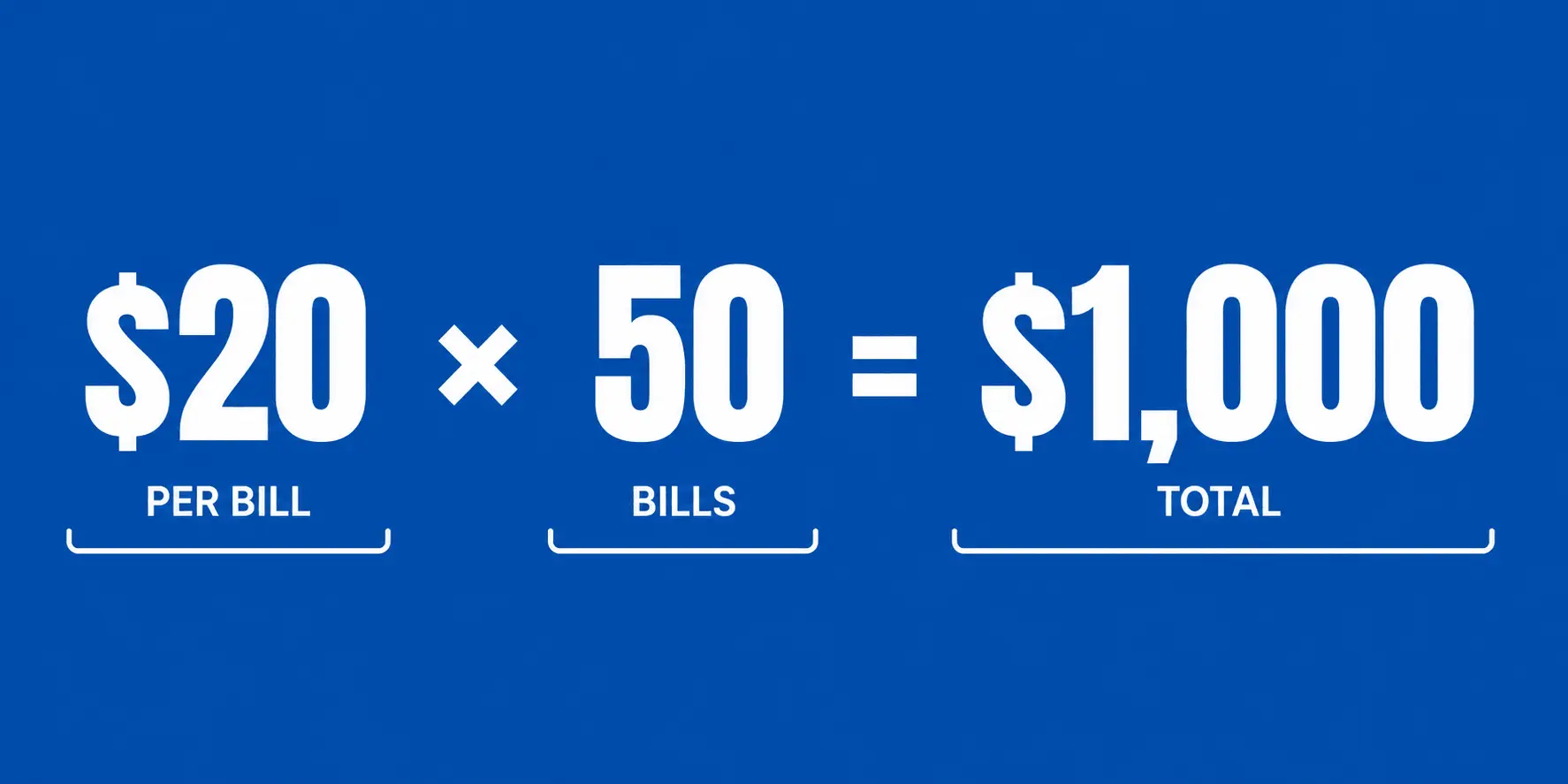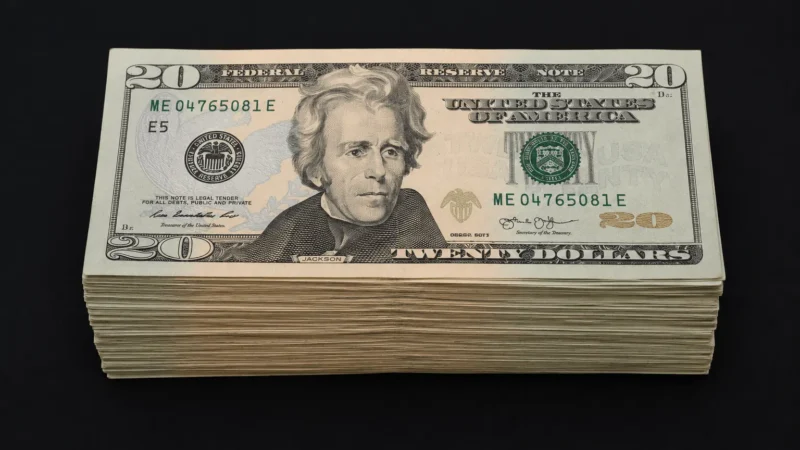
If you want to know how many $20 bills make $1000, the answer is exactly 50 bills. You get that by dividing $1000 by $20, which gives you 50. This guide goes well beyond that single answer. Whether you are preparing a bank deposit, counting down a register at the end of a shift, or just want a quick reference for any denomination and any amount, you will find everything you need right here. The tables below cover every common bill denomination from $1 to $100 for amounts ranging from $100 up to $100,000.
How Many $20 Bills Make $1000: The Direct Answer
It takes exactly 50 twenty-dollar bills to make $1,000. The math is simple: $1,000 divided by $20 equals 50. This is a number that experienced cashiers and bank tellers know by heart. In fact, the $20 bill is one of the most commonly circulated denominations in the United States. According to the Federal Reserve, $20 bills account for a large share of all currency in active circulation, which means this calculation comes up constantly in everyday cash handling.
Furthermore, knowing this number helps in several practical situations. For example, if your register shows $1,000 in $20 bills at the end of a shift, you should count exactly 50 bills. If you count 48 or 52, you know immediately that something needs investigating.
How Many $20 Bills Make Other Common Amounts
Once you know that 50 twenty-dollar bills make $1,000, the other amounts follow a simple pattern. Each additional $1,000 requires another 50 bills. So $2,000 needs 100 bills, $5,000 needs 250 bills, and so on. The table below covers the most common amounts so you have a quick reference for any situation.
| Total Amount | Number of $20 Bills | Verification |
|---|---|---|
| $100 | 5 bills | 5 x $20 = $100 |
| $200 | 10 bills | 10 x $20 = $200 |
| $500 | 25 bills | 25 x $20 = $500 |
| $1,000 | 50 bills | 50 x $20 = $1,000 |
| $2,000 | 100 bills (1 strap) | 100 x $20 = $2,000 |
| $5,000 | 250 bills | 250 x $20 = $5,000 |
| $10,000 | 500 bills | 500 x $20 = $10,000 |
| $20,000 | 1,000 bills (1 bundle) | 1,000 x $20 = $20,000 |
Notice that 100 twenty-dollar bills equals $2,000. This is also equal to one standard bank strap of $20 bills. A bank strap always contains exactly 100 bills of the same denomination. So when you see a violet-colored strap on a stack of $20 bills, you know instantly it is worth $2,000 without counting a single note.
How Many Bills of Each Denomination Make $1000
Of course, $20 bills are not the only way to make $1,000. The table below shows how many bills of each US denomination you need to reach $1,000. This is useful when you need to understand the most efficient way to make up a specific total.
| Denomination | Bills Needed for $1,000 | Bills Needed for $500 | Bills Needed for $100 |
|---|---|---|---|
| $1 bills | 1,000 | 500 | 100 |
| $2 bills | 500 | 250 | 50 |
| $5 bills | 200 | 100 | 20 |
| $10 bills | 100 | 50 | 10 |
| $20 bills | 50 | 25 | 5 |
| $50 bills | 20 | 10 | 2 |
| $100 bills | 10 | 5 | 1 |
As you can see, $100 bills are the most efficient. It only takes 10 of them to reach $1,000. However, $20 bills are far more practical for making change and everyday cash transactions, which is why they stay the most commonly used denomination for cash handling in retail and banking.
The Simple Formula for Any Amount
You do not need to look up a table every time. The formula is straightforward. To find how many twenty-dollar bills make any amount, divide the total by 20.
Number of $20 bills = Total amount divided by 20
Here are a few quick examples so you can see it in practice:
- How many $20 bills make $300? 300 divided by 20 equals 15 bills.
- How many $20 bills make $750? 750 divided by 20 equals 37.5 bills, which means $750 cannot be made with $20 bills alone. You would need 37 twenties ($740) plus one $10 bill.
- How many $20 bills make $1,400? 1,400 divided by 20 equals 70 bills.
- How many twenties make $3,000? 3,000 divided by 20 equals 150 bills.
For amounts that do not divide evenly by 20, our free Denomination Breakdown Calculator finds the most efficient combination of bills automatically.
Bank Straps and Bundles: What Professionals Use
When banks and businesses handle large numbers of $20 bills, they organize them into straps and bundles. This system makes large cash counts significantly faster because you work in fixed units rather than counting individual bills.
A bank strap always holds exactly 100 bills of the same denomination. Therefore, a strap of $20 bills is always worth $2,000. Ten straps make one bundle, which means a bundle of $20 bills holds 1,000 bills and is worth $20,000.
| Unit | Bills | Value ($20 bills) | ABA Strap Color |
|---|---|---|---|
| Single bill | 1 | $20 | N/A |
| Bank strap | 100 | $2,000 | Violet |
| Bundle (10 straps) | 1,000 | $20,000 | N/A |
The violet color on a $20 bill strap follows the American Bankers Association (ABA) color standard. Not all institutions follow this standard, so always read the denomination printed on the strap itself to confirm. For more detail on straps and bundles, read our guide on how many bills are in a bank strap.
Large Amount Reference: $20 Bills from $10,000 to $100,000
If you regularly handle vault counts, large deposits, or payroll disbursements, the table below gives you the number of $20 bills needed for larger totals.
| Amount | $20 Bills Needed | Bank Straps |
|---|---|---|
| $10,000 | 500 | 5 straps |
| $20,000 | 1,000 | 10 straps (1 bundle) |
| $50,000 | 2,500 | 25 straps |
| $100,000 | 5,000 | 50 straps (5 bundles) |
In addition, the US Currency Education Program provides detailed information on the $20 bill’s current design, security features, and production history. This is useful if you handle large volumes of cash and want to verify the authenticity features of $20 bills specifically.
Real-World Uses: When Does This Matter?
Preparing a Bank Deposit
When you take cash to the bank, tellers prefer bills organized by denomination and counted into neat groups. If you know your deposit includes $3,000 in $20 bills, you can confirm you have 150 bills before you walk in. This saves time at the counter and reduces the chance of errors.
Closing a Cash Register
When closing a register at the end of a shift, cashiers use denomination counts to verify the closing balance. If the register shows $1,000 in $20 bills, you count exactly 50 bills. Any discrepancy signals a potential error in the shift’s transactions. Use our free Cash Drawer Count Sheet to record and verify your count automatically.
Setting Up a Change Float
When opening a register at the start of a shift, you need enough bills and coins to make change efficiently. Knowing how many $20 bills fit into your float target helps you set the right starting balance without guessing. For example, a $200 float might include 5 twenties ($100), along with tens, fives, and ones for the remainder.